
In an era of increasing infrastructure costs and growing mandates for sustainable practices, municipalities face a critical decision: invest in traditional AC-powered traffic control systems or embrace the rapidly advancing capabilities of solar power. For engineers and city planners, the choice isn’t just about initial outlay; it’s about long-term ROI, reliability, and resilience.
At ELTEC, we understand the nuances of both technologies. This analysis cuts through the marketing hype to provide a clear, data-driven comparison, helping you make the most informed decision for your community’s safety and budget.
The Hidden Costs of AC-Powered Systems
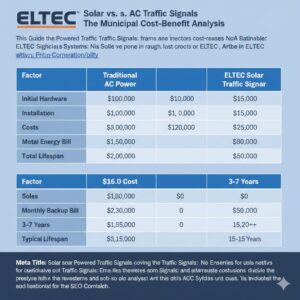
While conventional systems have a lower initial hardware cost, the installation and ongoing expenses can quickly escalate:
-
Trenching & Wiring: Digging trenches, laying conduits, and running electrical lines are major cost drivers, especially in established urban areas. Permitting, labor, and disruption to traffic add significant overhead.
-
Grid Dependency: AC systems are vulnerable to power outages, requiring backup battery systems (which have their own maintenance needs) or generators to maintain operation. This is particularly critical for emergency vehicle preemption (EVP) systems.
-
Utility Bills: Ongoing energy consumption, though often low per signal, accumulates across an entire city’s infrastructure.
-
Environmental Impact: While reducing, the carbon footprint of grid power is still present, which can clash with city-wide sustainability goals.
The Advantages of Solar-Powered Systems
Modern solar traffic systems have evolved beyond niche applications to become a viable, and often superior, option for a wide range of pedestrian and traffic control needs.
-
Reduced Installation Costs:
-
No Trenching: Eliminating the need to connect to the grid significantly reduces labor, equipment, and permitting costs. Installation time can be cut by up to 70%.
-
Remote Deployment: Solar allows for signal installation in locations far from existing power infrastructure, such as rural intersections or new school zones.
-
Federal Funding: Many solar projects qualify for grants and incentives related to renewable energy and sustainable infrastructure. **
-
-
Enhanced Reliability & Resilience:
-
Power Outage Immunity: Solar systems operate independently of the grid, ensuring continuous functionality during blackouts, natural disasters, or infrastructure failures. This is invaluable for critical intersections and emergency routes.
-
Battery Technology: Advanced deep-cycle batteries (e.g., Lithium-ion, AGM) provide multi-day autonomy, ensuring operation even during extended periods of low sunlight.
-
Predictive Maintenance: ELTEC’s remote monitoring capabilities allow for proactive battery health checks and system diagnostics, minimizing downtime.
-
-
Environmental & Public Relations Benefits:
-
Zero Emissions: Operating on clean, renewable energy aligns with green initiatives and helps cities meet carbon reduction goals.
-
Community Perception: Demonstrating a commitment to sustainability can enhance public image and civic pride.
-
ELTEC’s Hybrid Approach: The Best of Both Worlds
While 100% solar is ideal for many applications, ELTEC also offers hybrid solutions that integrate solar power with minimal grid connection, or smart battery backups for AC systems. This flexibility ensures that every ELTEC solution is tailored to the specific demands of the location, traffic volume, and budget.
From solar-powered RRFBs in school zones to full-size, self-sufficient intersection signals, ELTEC’s engineering team designs for maximum efficiency and uptime, even in challenging climates.
Making the Right Choice for Your Municipality
The decision between solar and AC-powered traffic systems requires a thorough engineering analysis. Consider:
-
Location: Is grid power easily accessible? What are the trenching challenges?
-
Traffic Volume & Criticality: How essential is continuous operation?
-
Budget: Balance initial capital expenditures with long-term operational savings.
-
Sustainability Goals: Does the project need to align with green initiatives?
Contact ELTEC today for a customized consultation and a detailed cost-benefit analysis tailored to your specific project needs.
Additional Resources: https://www.energy.gov/eere/solar/solar-energy-technologies-office